Like many addictions, it starts as a psychological prop, a way of making
yourself feel more confident in social situations. At first you only do it on a
night out because everyone else does. But then you become dependent. Before you
know it, you're indulging first thing in the morning and then in the loo at work
when you think no one's looking. You do it after the gym and even on holiday.
You forget what you were like before the addiction took hold. The idea of living
without it sends a shiver of cold terror down your spine.
I talk not of narcotics, alcohol or cigarettes. I talk instead of something
that millions of women can relate to on an everyday basis: the simple act of
straightening one's hair.
Over the past decade, ironed-straight hair has become almost the default
style for white females of a certain age. At some point in the early noughties,
it seemed we all signed up to the cult of the poker-straight. Our obsession was
fuelled by advances in technology and the ready availability of salon-quality
straighteners on the high street. When ceramic-plated GHD hair straighteners
first hit the shelves, we rushed en masse to grab a pair capable of transforming
our frizzy mops into long, sleek manes worthy of a member of Atomic Kitten.
Everyone was doing it. Even Jennifer Aniston, propagator of that iconic layered
mid-90s haircut "The Rachel", went straight.
In the grip of our addiction we didn't care about the damage done to our
split ends or the occasional forehead burn or the times we had to dash back to
the house, panicked that we'd left our straighteners on and they were burning a
hole through the carpet.
I was no exception. With my straighteners I could iron the natural kink out
of my hair in five minutes every morning. It was quicker and easier than getting
a blow-dry. When I started my first job on a newspaper, I told myself that
straight hair looked more professional than my customary tangle. Soon the
straighteners were just another part of my morning routine. I was so attached to
them I once took a pair on assignment to Mali – even though I was staying in a
hotel with no electricity. For the best part of a decade I was a slave to the
straightener. I didn't think to question my subservience because everyone else
was doing it, too.
Advertisement
But now something strange is happening. Silently, stealthily, a generation of
women has emerged from under the steaming shadow of 230C heat. And hair has once
again become something to experiment with. Blow-dry bars have sprung up in city
centres. Extensions are something you do to your scalp rather than the
side-return of your house. A battery of gadgetry has reached salon shelves:
curling tongs and hot rollers and hair extensions and Argan oil and dry shampoo.
Pop stars such as Katy Perry and Kelly Osbourne are dyeing their hair shocking
pink and purple. Lady Gaga wears oversize bows made of hair. Women grow fringes
to be like Lou Doillon, sport undercuts to emulate Rihanna and style
peroxide-blonde mohicans in homage to Emeli Sandé, and no one bats an
eyelid.
"It's not one, iconic haircut any more," explains Luke Hersheson, an
award-winning stylist and a brand ambassador for L'Oréal Kérastase. "People used
to embrace having the same haircut as Jennifer Aniston. Now there are 20 or 30
new trends, and individuality is so much more important."
Hersheson says that social networks such as Twitter and Instagram, which
enable celebrities to establish direct relationships with their fans, have meant
that we are now able to leap on new trends far more quickly.
"We've always had celebrity influence, but the world's a lot smaller,"
Hersheson says. "When I was starting out in the early 90s, the only way I could
find out what was happening was to assist hairdressers at a catwalk show. Those
pictures were not released to the public for six months. Now I just go home and
log on. The accessibility has changed massively."
Today hair is once again becoming a statement of individualism. Just in time,
as it happens, because a few weeks ago my straighteners broke and my hair
reverted to its untampered state: a nondescript wave that is neither one thing
nor the other.
But the odd thing was that I no longer felt leaving the house without
straightened hair was the visual equivalent of going out in public missing some
vital item of clothing. Instead my female acquaintances were overwhelmingly
positive.
Hair: Rihanna ‘Hair is once again becoming a statement of
individualism’: Rihanna Photograph: Rex
My cousin said my hair looked better than she'd ever seen it. Some – like my
friend Olivia – were almost affronted that I'd been hiding my curls from them
for so long, as though I'd been leading a follicular double life. "You should
leave your hair exactly as it is," Olivia insisted. "Throw the straighteners
out."
The men I know were less sure. They thought my hair made me seem "a bit zany
– like Minnie Driver". One male acquaintance cited Anita Roddick. My husband
diplomatically said he liked it both curly and straight, which is basically why
I married him. Interestingly, everyone I spoke to believed it made me look
younger.
For women, hair is a tricky business. Straight or curly, it comes loaded with
cultural meaning – a social symbol that, unlike clothing, is an intrinsic part
of the body and one which grows on a daily basis.
"Hair is called a secondary sexual characteristic," says Philip Kingsley, one
of the UK's leading trichologists, and the man who coined the term "bad hair
day". "You can't flaunt your primary sexual characteristics in public, at least
not in western society, so that's what makes your hair so important from a
social viewpoint: it's about sexuality and morale. Lots of women, and men, find
that if they are not happy with their hair then they are unhappy people."
Hair is a genetic inheritance, a marker of our biological roots, and yet the
vast majority of us manipulate it through our lifetimes. The styling of our hair
is, says Dr Sarah Cheang, a senior tutor at the Royal College of Art, a form of
"social signalling". According to Cheang, who co-edited the book Hair: Styling,
Culture and Fashion, our impulse to straighten, dye or curl our hair comes from
a psychological need to disguise who we really are. When hair continues to grow,
it threatens to betray our biological roots or our so-called "natural" identity
to others.
"We may have decided that our 'true' or 'correct' identity should be
something else," she says. "Thus hair might need to be dyed, bleached,
straightened, curled or hastily removed."
As a result we bombard our hair with treatments. We allow it to affect our
moods, and we treat it as a means of both adornment and self-expression. When we
lose it – through alopecia or chemotherapy – the trauma is intense.
The issue becomes even more complex for black women, for whom straight hair
can often only be achieved through great expense, the application of dangerous
chemicals and the endurance of physical pain. Straightening the natural texture
of black people's hair has been perceived as pacifying a culture dominated by
white ideals of beauty – but that is another, even more politically charged
story.
All of this contributes to the fact that the average woman in the UK spends
£26,500 on her tresses over her lifetime. A quarter of the respondents to a 2010
poll of 3,000 people said they would rather spend money on their hair than food.
And although the grim economic climate has seen visits to hair salons drop off,
an increasing number of women are styling their hair at home.
A consumer report by Mintel states that ownership of hair-styling products
has expanded by 4.4 million adults between 2007-10. Twenty million women own a
hair dryer and more than 5 million own straighteners (25% of whom say they
couldn't live without them).
But why do we bother? Why do we feel this need to tamper with our hair?
Hersheson sees it as part of an inherent human covetousness: "It's part of our
being to want something we haven't got. We've got a natural, built-in desire to
enhance, change or experiment."
This could be true. A natural brunette, I remember being desperate to have
blonde hair as a teenager because it seemed that all the boys fancied Pamela
Anderson. It turns out there is plenty of historical precedent for blondes being
more admired. The Edwardian explorer M French Sheldon claimed to have dazzled
the locals in East Africa in 1906 with a white gown and a long blonde wig that
apparently rendered her all-powerful and untouchable. But colour is a fluid
concept.
"Blondeness used to be a sign of youth," says fashion historian Caroline Cox.
"Now, because so many women post-50 are dyeing their hair blonde, it's a sign of
maturity, and young women are increasingly dyeing their hair in a grey tone
that's almost silver or pale blue."
Hair cut, too, has long been a social signifier. When the bob gained
popularity in the 1920s it was emblematic of a new era of modernity and women's
emancipation in the aftermath of the First World War – a literal cutting-off
from outdated Edwardian traditions. In the 1960s both men and women grew their
hair long to rebel against accepted establishment norms. In the 1980s the first
wave of women in the workplace often cut their hair short in order to fit into a
male-dominated environment (in Working Girl, Mike Nichols's 1988 film about a
secretary who yearns to become a businesswoman, there is a seminal moment in
which the protagonist, Tess, is so desperate to be taken seriously that she cuts
off her soft blonde hair).
These days, according to Cox, the dominant trend is for styling rather than
cutting, and for "glamorous, long hair, and lots of it". It is a look that
crosses the social divide and yet simultaneously emphasises it. There is an
assumption that pneumatic glamour models and female cast members of Towie rely
on "fake" hair extensions, whereas the luscious natural locks of the Duchess of
Cambridge bespeak a woman with the time and money to devote to a deluxe
blow-dry.
Hair: Kate, the Duchess of Cambridge The glossy mane – a product of
the deluxe blow-dry: the Duchess of Cambridge. Photograph: Nicolas
Asfouri/AP
Other famous proponents of the glossy mane include the caramel-tinted Kim
Sears – when her boyfriend Andy Murray won Wimbledon, the BBC devoted almost as
many camera angles to capturing the rippling movements of Kim's astonishing hair
as it did to the tennis. As a result of this trend, the UK is now the third
largest importer of human hair in the world, with £38m worth entering the
country in 2011 and a 70% market growth in the last five years. There are even
reports of Russian prisoners having their heads shaved against their will and
the harvesting of hair from corpses to meet the surge in demand.
"It's a traditional idea of female glamour and it's kind of boring," says
Cox. "It's the whole pole-dancer look: huge heads of artificial hair, faces that
look as if they've been dipped in a bucket of make-up, ultra short skirts and
huge stripper heels. In terms of fashion and feminism, it's like: oh my God –
what was I fighting for?"
Big, fake hair has reached the workplace, too – as evidenced by the female
candidates on the recent series of The Apprentice, one of whom made repeated
references to her "voluminous" bleached-blonde locks on her CV.
Karin Lesnik-Oberstein, a professor of critical theory at the University of
Reading and editor of The Last Taboo: Women and Body Hair, sees this as part of
a broader trend towards cosmetic enhancement.
"There's an idea now that the more successful a woman is, the more glamorous
and sexy she should be," she says. "If not, she has sacrificed her femininity.
It's the same with cosmetic surgery or Botox. It goes with the idea of 'having
it all' – because if you're a boss and also a woman who doesn't comply with
trying to look sexually attractive, then really you're like a man and you become
a castrated bitch."
And because the semiotics of a woman's hair are so complex, so inextricably
linked with the story she wants to tell about herself and so shaped by the
outside forces of gender, commerce and culture, it is truly shocking when
someone subverts the narrative.
Hair: Jessie J ‘Short hair is still equated
with masculinity’: Jessie J. Photograph: Andy Sheppard/Getty
When Britney Spears shaved her head in full public view in 2007, it was
viewed as disturbing physical evidence of a mental breakdown. And although in
recent years it has become more common for women to have partially shaved heads
as fashion statements, it remains rare to see a female celebrity embracing a
full buzz cut unless it is for charity (as Jesse J did to raise money for Red
Nose Day) or professional reasons (as Charlize Theron did for an upcoming
role).
"Short hair is still equated with masculinity," says Lesnik-Oberstein. "I
have very short hair, and in England I often get mistaken for a man. It happened
to me recently with two older ladies who mistook me for a man in the loo and
said: 'Sir, this is a ladies' loo' very politely. They were mortified when I
told them I was actually a woman. That never happens to me on the continent –
for instance in Germany or Holland, where a lot of these societies are more
egalitarian and matriarchal."
By contrast the looseness of long hair is said to suggest both a moral
looseness and a natural sensuality – it was partly for this reason that
Victorian women only ever "let their hair down" in private and why many
religious faiths still require women to cover their heads completely. Long hair
recurs frequently in fairy tales as a metaphor for sexuality, serving to remind
us how close and how distant we are from the animal within, whereas tied-up hair
is used in popular culture to denote the sexually repressed or uptight.
According to Harvard academic Thom Hecht, "disciplined" hair symbolises "the
unseen disciplined mind". In his essay "Hair Control: the Feminine Disciplined
Head", he explains that a ballerina's swept-back chignon reflects the supreme
physical control exercised over her own body.
Elizabeth Day with a ponytail.
Elizabeth Day with a ponytail. Photograph: Phil Fisk for the Observer
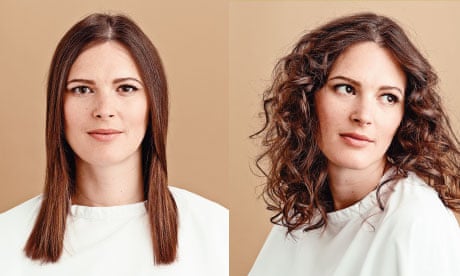
All of which could explain why, when I had my hair styled in a tight ponytail
for the shoot accompanying this feature, most people who saw me thought I looked
"unapproachable" (which might simply be a polite way of saying: "You looked like
you had a rattail and a Croydon facelift"). By contrast, the hairstyle with
natural waves was deemed the most likeable. Poker-straight hair was, the
photographer said, "cold and expressionless".
But for me, the biggest revelation was how liberated I felt with curly hair.
There was something about the lightness of it, the way it bounced as I walked,
that made me feel happier – perhaps because I wasn't spending the entire day
worrying about whether my hair would frizz hideously if it made contact with
water. And I suppose it felt more natural, too, less like I was trying to be
something I'm not.
But "naturalness", says Sarah Cheang is "a socially constructed concept like
any other". That is to say, because hair grows continuously, the management of
it whether by cutting or styling is – and always has been – an essential part of
human social existence.
And in truth I'm not sure I'll be ditching the hair straighteners
immediately. I definitely feel more comfortable experimenting with different
styles than I used to, but I'm not sure I'm quite ready to abandon a decade's
worth of personal grooming experience. It's going to be a gradual process of
weaning myself off the GHDs before I get myself back on to the straight and
narrow. In a manner of speaking, that is.
Elizabeth Day's hair was styled by Marc Trinder, art team director at Charles
Worthington (020 7631 1370; charlesworthington.com)